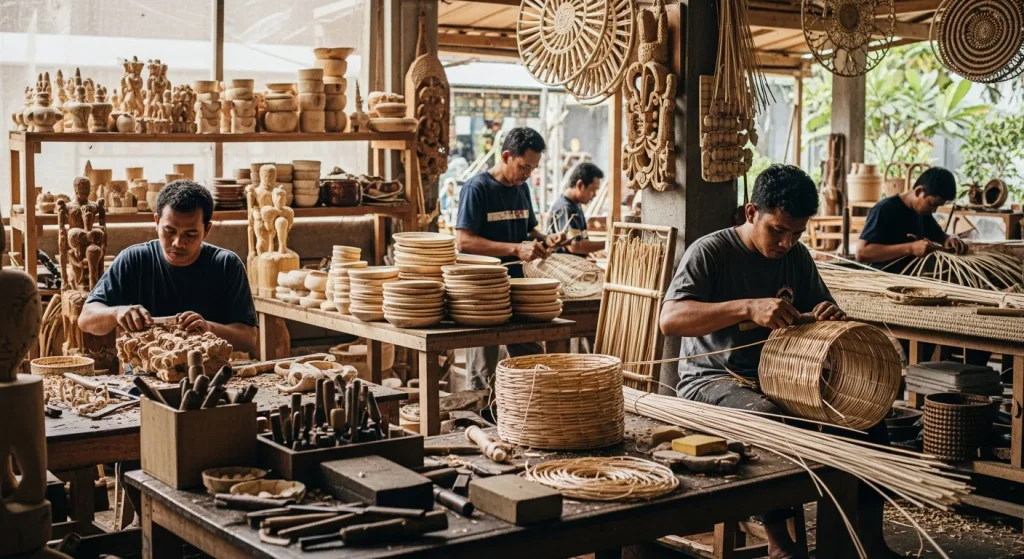
The Indonesian home decor market, including products from Bali, is projected to grow from approximately USD 10.1 billion in 2024 to USD 11.1–11.3 billion by 2027, representing an annual growth rate of about 3–4%. Bali home decor wholesale is a niche, export-driven segment, showing faster growth than the domestic average due to international demand.
Comparison: Bali vs. Indonesian Home Decor Wholesalers for Global Buyers
For importers, wholesalers, retailers, and interior contractors worldwide, sourcing home decor from Indonesia offers a diverse range of products. Understanding the distinctions between general Indonesian wholesalers and those specifically based in Bali is crucial for strategic procurement.
1. Market Size & Growth (Indonesia/Bali Context)
The overall Indonesia home decor market reached USD 10.07 billion in 2024 and is projected to reach USD 14.19 billion by 2033, demonstrating a 3.88% Compound Annual Growth Rate (CAGR) from 2025–2033. IMARC’s 2025 value of USD 10.46 billion and 3.73% CAGR from 2026–2034 implies an Indonesia market value of roughly USD 10.9–11.2 billion by 2027.
A separate Indonesia-focused study (6Wresearch) indicates that the home decor market in Indonesia is expected to record a growth rate of 9.85% by 2027, set against strong regional competition in Asia. This 9.85% is framed as a market “growth rate by 2027,” rather than a long-term CAGR, suggesting near-term acceleration driven by rising middle-class incomes and urban renovation demand.
Implication for Bali Wholesale: Bali’s home decor output, encompassing furniture, handicrafts, and natural-material decor, is largely accounted for within Indonesia’s furniture and handicraft exports and domestic tourism spending. No major source isolates “Bali home decor” numerically. Given Bali’s role as a major artisanal and tourism hub and the strong export orientation of many producers, a reasonable working assumption is that Bali-linked production accounts for a mid-single-digit percentage of Indonesia’s home decor and handicraft economy. Export-oriented producers often grow above the 3–4% national decor CAGR, particularly when catering to Western and Asia-Pacific importers.
2. Product Specialisation and Aesthetic
Indonesian Home Decor Wholesalers (General)
Indonesian wholesalers outside Bali typically offer a broader spectrum of styles, reflecting the diverse cultural heritage across the archipelago. This includes:
- Java: Known for classic colonial furniture, teak wood craftsmanship, and intricate carvings. Products often have a more traditional or antique aesthetic.
- Sumatra: Textiles such as Songket and Ulos, along with wooden carvings and decorative items from various ethnic groups.
- Kalimantan: Focus on rattan and other natural fibre products, often with indigenous patterns.
- Sulawesi: Unique woven textiles and wood carvings, particularly from the Toraja region.
These wholesalers may have access to larger-scale manufacturing facilities and a wider range of raw materials from different islands, potentially offering more standardised products or higher volume capabilities for certain items.
Bali Home Decor Wholesalers
Bali specialises in a distinct aesthetic that is globally recognised. This includes:
- Natural Materials: Extensive use of teak wood, suar wood, rattan, bamboo, seagrass, and other natural fibres.
- Artisanal Craftsmanship: A strong emphasis on hand-carved items, intricate detailing, and unique, often organic designs.
- Bohemian & Coastal Styles: Products frequently align with bohemian, coastal, tropical, and minimalist aesthetics, popular in Western markets.
- Wellness & Spa Decor: Items suitable for resort, spa, and wellness-focused environments, such as stone carvings, water features, and serene decorative pieces.
Bali wholesalers often work with smaller, specialised workshops and artisans, allowing for greater customisation and unique, design-led products. The focus is on the “Bali style” – a blend of traditional craftsmanship with contemporary design sensibilities.
3. Sourcing and Logistics Advantages
General Indonesian Wholesalers
Sourcing from general Indonesian wholesalers might involve navigating different islands and logistics chains. For instance, a buyer might need to coordinate shipments from Java for furniture and from Kalimantan for rattan. This can sometimes lead to more complex consolidation efforts if products are sourced from multiple, geographically dispersed manufacturers.
Bali Home Decor Wholesalers
Bali offers a concentrated sourcing environment. Many manufacturers, artisans, and export services are located within a relatively small geographical area, particularly in the southern and central regions of the island. This concentration provides:
- Ease of Consolidation: Simplified logistics for consolidating diverse products from multiple suppliers into a single container.
- Established Export Infrastructure: Bali has a mature export infrastructure, including freight forwarders, quality control agencies, and experienced export staff.
- Direct Access to Artisans: Buyers can often visit workshops directly, fostering closer relationships and facilitating custom orders.
This streamlined process can reduce lead times and simplify quality control for Bali-specific products.
4. Quality Control and Production Standards
General Indonesian Wholesalers
Quality control standards can vary significantly across different regions and manufacturers in Indonesia. Buyers need to establish clear specifications and potentially engage third-party inspection services, especially when dealing with new suppliers or those located in less accessible areas. Production scales can range from large factories with international certifications to small family workshops.
Bali Home Decor Wholesalers
Bali’s export-oriented market has fostered a strong understanding of international quality expectations. Many Bali wholesalers have established robust internal quality control processes due to their consistent engagement with international buyers. They are typically more attuned to Western standards for finishing, durability, and material sourcing. While varying, many Bali producers also adhere to sustainable sourcing practices, particularly for wood and natural fibres, which is increasingly important for global buyers.
5. Pricing and Minimum Order Quantities (MOQs)
General Indonesian Wholesalers
Pricing can be highly competitive, especially for large volume orders of standardised products. MOQs can vary widely depending on the manufacturer’s capacity. Some larger factories may have higher MOQs, while smaller workshops might be more flexible. Price variations can also reflect regional differences in labour and raw material costs.
Bali Home Decor Wholesalers
Due to the artisanal nature and often higher design input, Bali products may have a perceived higher price point compared to mass-produced items from other regions. However, this is balanced by the unique aesthetic and craftsmanship. MOQs are often flexible, with many Bali wholesalers catering to smaller initial orders to build relationships, though price advantages typically accrue with larger volumes. Customisation costs are generally factored in transparently.
6. Cultural Nuances and Communication
General Indonesian Wholesalers
Communication can sometimes be a challenge, particularly in less export-focused regions where English proficiency may be lower. Cultural business practices vary across Indonesia, requiring patience and understanding from international buyers.
Bali Home Decor Wholesalers
Bali has a long history of international trade and tourism. English is widely spoken in business circles, and many wholesalers are accustomed to Western business communication styles and expectations. This facilitates smoother negotiations, clearer understanding of requirements, and more efficient problem-solving. Cultural nuances are still present but are generally well-understood by experienced Bali exporters.
7. 2027 Note
By 2027, the Indonesian home decor market is expected to show accelerated growth, with some projections indicating a growth rate of 9.85%. This near-term acceleration, driven by rising middle-class incomes and urban renovation demand, will likely increase domestic competition for raw materials and skilled labour. Export-oriented Bali wholesalers will need to maintain strong relationships with their supply chains to ensure consistent quality and timely delivery amidst this expanding domestic activity.
Summary Comparison Table
| Feature | General Indonesian Wholesalers | Bali Home Decor Wholesalers |
|---|---|---|
| Product Range | Broad, diverse styles from across Indonesia (Java, Sumatra, etc.) | Specialised “Bali style”: natural materials, bohemian, coastal, artisanal |
| Aesthetic | Traditional, colonial, diverse regional ethnic styles | Organic, handcrafted, modern tropical, wellness-oriented |
| Sourcing & Logistics | Potentially dispersed, complex consolidation if multi-regional | Concentrated, established export infrastructure, easier consolidation |
| Quality Control | Varies widely, requires due diligence per region/supplier | Generally attuned to international standards, robust internal QC |
| Pricing | Competitive for volume, varying MOQs, regional cost differences | Value-driven for unique designs, flexible MOQs, customisation options |
| Communication | Can vary, potential language barriers in non-export areas | Generally proficient English, familiar with Western business practices |
| Market Focus | Broad domestic & international | Primarily international export & tourism-driven |
Choosing between general Indonesian wholesalers and those specifically in Bali depends on the buyer’s specific needs, target market, and desired aesthetic. For unique, artisan-crafted items with a distinct tropical, bohemian, or wellness-oriented aesthetic, Bali offers a concentrated and experienced sourcing environment. For broader, more traditional, or large-volume standardised products, exploring wholesalers across other Indonesian islands may be more appropriate.
For those seeking the distinctive Bali aesthetic and a streamlined export process, request a wholesale quote on WhatsApp from Bali Home Decor Wholesale.