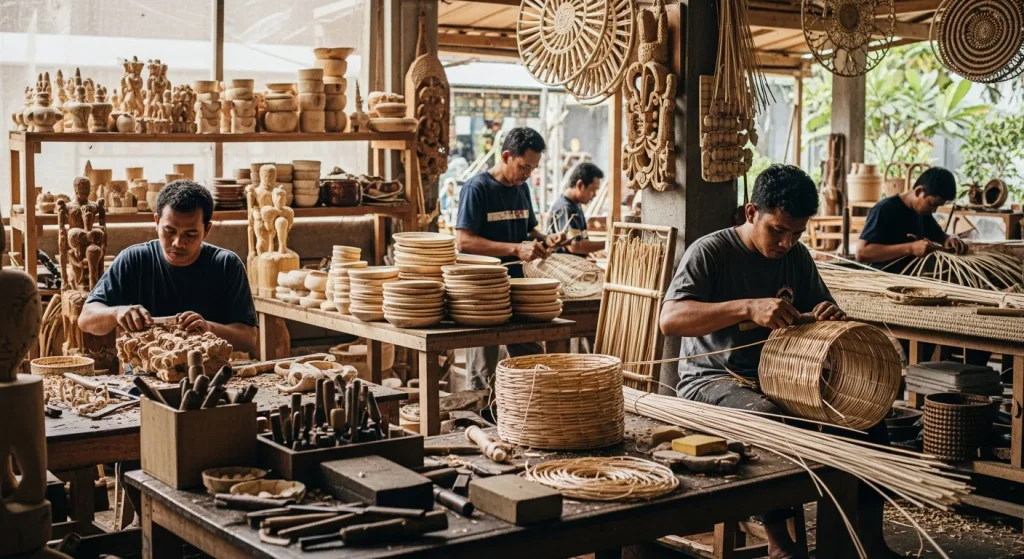
The Indonesian home decor market, including Bali-made products, is projected to grow from approximately USD 10.1 billion in 2024 to USD 11.1–11.3 billion by 2027, demonstrating an annual growth rate of 3–4%. Bali home decor wholesale represents a strategically significant export-driven segment, experiencing growth above the national average due to international demand and e-commerce expansion.
Buyer Guide: How to Wholesale Authentic Bali Home Decor for Your Retail Store
As an importer, wholesaler, or trade buyer, securing authentic Bali home decor requires understanding market dynamics, sourcing strategies, quality control, and logistical considerations. This guide provides a factual framework for wholesale procurement process from Bali.
1. Market Size & Growth (Indonesia/Bali Context)
The Indonesia home decor market reached USD 10.07 billion in 2024. Projections indicate growth to USD 14.19 billion by 2033, with a Compound Annual Growth Rate (CAGR) of 3.88% from 2025–2033. IMARC’s 2025 valuation of USD 10.46 billion and a 3.73% CAGR from 2026–2034 suggests the Indonesian market will be approximately USD 10.9–11.2 billion by 2027.
A separate study by 6Wresearch notes the home decor market in Indonesia is expected to record a growth rate of 9.85% by 2027. This rate is presented as a near-term growth acceleration, rather than a long-term CAGR, and is higher than IMARC’s medium-term average. This suggests an increase in demand driven by rising middle-class incomes and urban renovation projects within Indonesia.
Implication for Bali Wholesale
Bali’s home decor output, encompassing furniture, handicrafts, and natural-material decor, is predominantly integrated into Indonesia’s overall furniture and handicraft export figures, as well as domestic tourism spending. Specific statistical isolation of “Bali home decor” is not available from major sources.
Given Bali’s established role as a major artisanal and tourism centre, alongside the strong export orientation of many local producers, a reasonable working assumption is that Bali-linked production constitutes a mid-single-digit percentage of Indonesia’s broader home decor and handicraft economy. Export-oriented producers from Bali often achieve growth rates exceeding the national 3–4% decor CAGR, particularly when they cater to Western and Asia-Pacific importers who are experiencing their own market expansion.
2027 Note
By 2027, the Indonesian home decor market is anticipated to show a near-term acceleration in growth, potentially reaching a growth rate of 9.85%, indicating a robust environment for sourcing and exporting Bali home decor. This is driven by internal demand factors and sustained international interest.
2. Defining ‘Authentic Bali Home Decor’
Authentic Bali home decor is characterised by its adherence to traditional Balinese craftsmanship, materials, and aesthetic principles. This typically involves handmade items using sustainably sourced local materials.
Characteristics of Authentic Bali Decor:
- Materials: Predominantly natural materials such as teak wood, suar wood, rattan, bamboo, natural fibres, stone (e.g., lava stone, river stone), and shells.
- Craftsmanship: Hand-carved wooden items, hand-woven textiles, intricate traditional motifs, and artisanal finishing techniques.
- Design Philosophy: Often reflects Balinese spiritual and cultural influences, incorporating elements inspired by nature, Hindu mythology, and daily island life. Designs can range from rustic and organic to intricately detailed and ornate.
- Production Location: Primarily produced by local artisans and workshops across Bali, ensuring the skills and techniques are indigenous to the island.
3. Sourcing Channels for Wholesale Buyers
Wholesale buyers have several established channels for sourcing authentic Bali home decor. Each channel presents distinct advantages and considerations.
Direct from Manufacturers/Artisans
Engaging directly with manufacturers or artisan workshops in Bali allows for customisation, direct negotiation on pricing, and a deeper understanding of the production process. This channel requires significant time and local knowledge for identification, vetting, and relationship building.
Export Houses/Wholesale Suppliers (e.g., Bali Home Decor Wholesale)
Partnering with established export houses simplifies the sourcing process. These companies typically offer:
- Curated Collections: Access to a wide range of vetted products from multiple artisans.
- Quality Control: Internal quality assurance processes to ensure products meet international standards.
- Logistics Management: Handling of packaging, freight forwarding, customs documentation, and shipping worldwide.
- Consolidation: Ability to consolidate orders from various suppliers into a single shipment.
- Communication: Professional communication and order management in English.
Trade Fairs and Exhibitions
Attending international trade fairs (e.g., Ambiente in Germany, Maison&Objet in France) or regional fairs in Indonesia (e.g., IFEX, TEI) provides opportunities to meet multiple suppliers, view product ranges in person, and assess market trends. While not always direct from Bali, many Bali-based exporters exhibit at these events.
4. Quality Control and Compliance
Maintaining product quality and ensuring compliance with international standards is crucial for wholesale imports.
Key Quality Control Measures:
- Material Inspection: Verifying the type, grade, and origin of raw materials (e.g., legal wood certification).
- Workmanship Assessment: Inspecting for defects in carving, weaving, finishing, and assembly.
- Dimensional Accuracy: Checking product dimensions against specifications.
- Packaging Standards: Ensuring robust packaging suitable for international shipping to minimise transit damage.
Compliance Considerations:
- Legal Wood: Verifying compliance with regulations like the EU Timber Regulation (EUTR) or US Lacey Act for wooden products.
- Fumigation: Ensuring all wooden items are properly fumigated and certified for import.
- Labelling: Correct product labelling, including country of origin.
- Customs Regulations: Adhering to the import regulations of the destination country.
5. Logistics and Shipping
Efficient logistics are vital for cost-effective and timely delivery of wholesale orders.
Shipping Options:
| Shipping Method | Description | Typical Transit Time (to Europe/North America) | Cost Consideration |
|---|---|---|---|
| Sea Freight (FCL) | Full Container Load. Cost-effective for large volumes. | 4-8 weeks | Lowest per unit cost for high volume |
| Sea Freight (LCL) | Less than Container Load. Good for smaller volumes, consolidated with other cargo. | 4-8 weeks | Higher per unit cost than FCL, lower than air freight |
| Air Freight | Fastest option, suitable for urgent or high-value, low-volume goods. | 3-7 days | Highest per unit cost |
Key Logistics Steps:
- Packaging: Professional export packaging (e.g., cartons, wooden crates) is essential.
- Documentation: Commercial invoice, packing list, bill of lading/airway bill, certificate of origin, fumigation certificate, and any necessary permits.
- Customs Clearance: Working with a customs broker in the destination country.
- Insurance: Cargo insurance is highly recommended to protect against loss or damage during transit.
6. Building Long-Term Relationships
Successful wholesale sourcing from Bali often relies on establishing strong, trust-based relationships with suppliers.
Relationship Building Strategies:
- Clear Communication: Articulate requirements, expectations, and feedback precisely.
- Regular Visits: If feasible, periodic visits to Bali strengthen personal connections and oversight.
- Fair Practices: Adhering to agreed payment terms and showing respect for local culture.
- Feedback Loop: Provide constructive feedback to help suppliers improve and meet your specific needs.
By systematically addressing these aspects, wholesale buyers can effectively source authentic Bali home decor, ensuring quality, compliance, and a reliable supply chain for their retail operations.
For further assistance with your wholesale procurement needs, request a wholesale quote on WhatsApp.