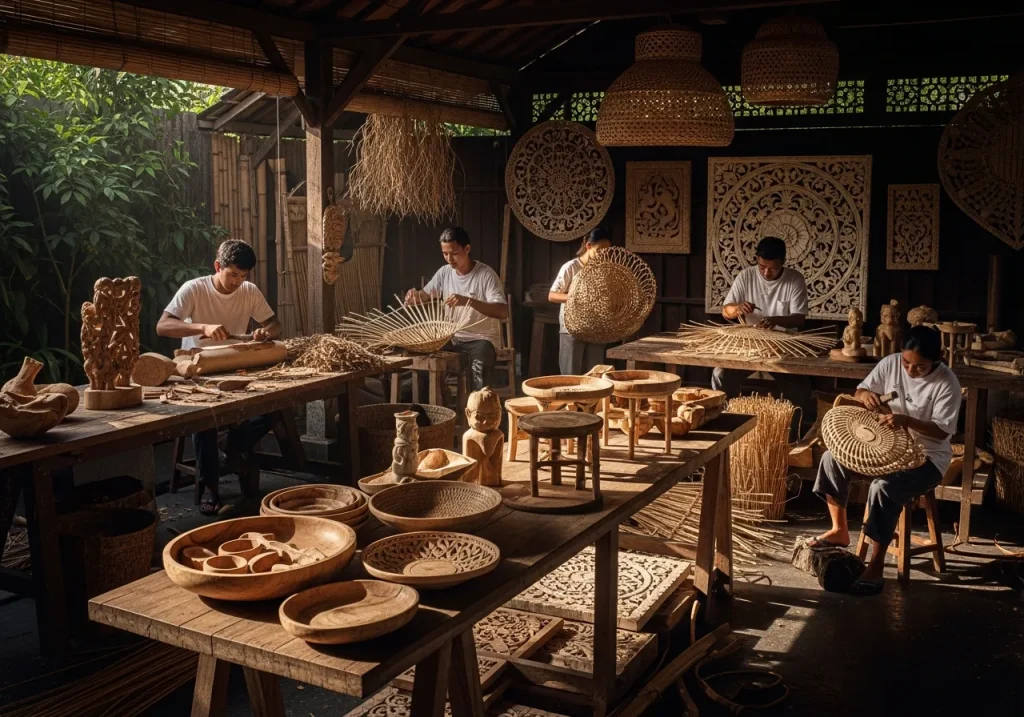
The Indonesian home decor market, including Bali products, is projected to grow from approximately USD 10.1 billion in 2024 to USD 11.1–11.3 billion by 2027, exhibiting an annual growth rate of about 3–4%. Bali home decor wholesale is a strategically important export segment, driven by international demand and e-commerce, and often grows faster than the domestic average.
Comparison: Teak, Rattan, and Succar: Best Materials for 2027 Wholesale Bali Home Decor
As export sales director and senior content lead for Bali Home Decor Wholesale, I provide this market briefing and material comparison for our global network of importers, wholesalers, retailers, interior contractors, and trade buyers. Our focus is on the materials best positioned for the 2027 market, specifically teak, rattan, and succar, within the context of the growing Indonesian and Bali home decor sector.
Market Size & Growth: Indonesia and Bali Context (2024–2027)
The Indonesian home decor market reached USD 10.07 billion in 2024 and is projected to reach USD 14.19 billion by 2033, with a Compound Annual Growth Rate (CAGR) of 3.88% from 2025–2033. IMARC’s 2025 valuation of USD 10.46 billion and a 3.73% CAGR from 2026–2034 imply an Indonesian market value of approximately USD 10.9–11.2 billion by 2027. A separate Indonesia-focused study by 6Wresearch indicates a projected growth rate of 9.85% for the home decor market by 2027, suggesting a near-term acceleration driven by rising middle-class incomes and urban renovation demand, particularly in the context of strong regional competition in Asia.
Implication for Bali Wholesale
Bali’s output in home decor, encompassing furniture, handicrafts, and natural-material decor, is primarily accounted for within Indonesia’s broader furniture and handicraft export figures and domestic tourism spending. No major statistical source isolates “Bali home decor” numerically. However, given Bali’s significant role as an artisanal and tourism hub, and the strong export orientation of many local producers, a reasonable working assumption is that Bali-linked production constitutes a mid–single-digit percentage of Indonesia’s overall home decor and handicraft economy. Export-oriented producers in Bali frequently demonstrate growth rates exceeding the national 3–4% home decor CAGR, particularly those serving Western and Asia-Pacific importers who are experiencing their own market expansion.
2027 Note: Material Demand Drivers
By 2027, demand for sustainable and natural materials in home decor is expected to solidify further. Consumers and B2B buyers will increasingly prioritise products with verifiable ethical sourcing and a clear environmental narrative. This trend directly benefits materials like teak, rattan, and succar, provided their supply chains meet transparency and sustainability standards. The projected market acceleration in Indonesia, coupled with sustained international interest in unique, handcrafted items, will place a premium on materials that offer both aesthetic appeal and responsible provenance.
Material Comparison: Teak, Rattan, and Succar for 2027
Selecting the appropriate materials for wholesale home decor is a strategic decision that impacts product longevity, aesthetic appeal, and market positioning. For 2027, teak, rattan, and succar remain prominent choices from Bali, each offering distinct advantages.
Teak (Tectona grandis)
Teak is a dense, coarse-grained hardwood indigenous to tropical regions. Its reputation for durability, strength, and resistance to rot, termites, and moisture makes it a premium material for both indoor and outdoor furniture and decor items. Teak’s natural oils provide inherent protection, reducing the need for extensive chemical treatments.
Advantages of Teak:
- Durability: Exceptional resistance to weather, pests, and decay, ensuring a long product lifespan. This is critical for outdoor furniture and high-traffic interior pieces.
- Aesthetics: Develops a distinctive silver-grey patina over time if left untreated outdoors, or maintains a rich golden-brown hue indoors with regular oiling. Its natural grain patterns are highly valued.
- Strength: Suitable for structural components in furniture, capable of supporting significant weight and resisting impact.
- Market Value: Commands a higher price point due to its quality and longevity, appealing to premium segments.
Considerations for Teak:
- Cost: Generally the most expensive of the three materials due to its slow growth rate and high demand.
- Weight: Denser and heavier than rattan or succar, which can impact shipping costs and handling.
- Sourcing: Buyers must ensure teak is sourced from certified sustainable plantations (e.g., FSC-certified) to avoid illegal logging and meet international environmental standards. Indonesia has made significant strides in this area.
Rattan (Calamus rotang)
Rattan is a climbing palm found in tropical regions, primarily Southeast Asia. It is a flexible, fibrous material used for weaving furniture, baskets, and decorative accents. Unlike bamboo, which is hollow, rattan is solid and can be bent and shaped into intricate designs.
Advantages of Rattan:
- Flexibility & Workability: Highly pliable when heated, allowing for complex curves and woven patterns. This facilitates diverse design possibilities.
- Lightweight: Significantly lighter than teak, reducing shipping costs and making furniture easy to move.
- Sustainability: A fast-growing, renewable resource. Its harvesting often encourages forest preservation as it grows in conjunction with trees.
- Aesthetics: Offers a natural, organic look, available in various finishes from natural light tones to darker stains. Complements a range of interior styles, from bohemian to contemporary.
Considerations for Rattan:
- Durability: While strong, it is less resistant to moisture and direct sunlight than teak, making it primarily an indoor material unless specifically treated for outdoor use.
- Maintenance: Requires cleaning to prevent dust accumulation in woven areas. Can dry out and become brittle if exposed to extreme conditions without proper care.
- Price Point: Generally more affordable than teak, making it suitable for broader market segments.
Succar (Sugar Palm Fibre)
Succar, or sugar palm fibre (Arenga pinnata), is derived from the black fibres of the sugar palm tree. This material is traditionally used in Indonesia for ropes, brushes, and roof thatch due to its strength and resistance to saltwater and insects. In home decor, it is increasingly being incorporated into unique decorative items, baskets, and textural elements.
Advantages of Succar:
- Durability & Resilience: Known for its strength, stiffness, and resistance to saltwater, insects, and decay. This makes it suitable for items requiring robustness.
- Unique Texture: Offers a distinctive, coarse, and rustic texture that adds an organic and earthy feel to products.
- Sustainability: A natural, renewable resource. The fibres are harvested from mature palm trees without harming the tree itself.
- Versatility: Can be woven, twisted into ropes, or used as a decorative accent. Its dark, natural colour provides a strong contrast.
Considerations for Succar:
- Aesthetics: Its coarse texture and dark colour may not suit all design preferences or interior schemes. It is often used for accent pieces rather than primary furniture.
- Workability: Less flexible than rattan, limiting its use for intricate curves or fine weaving.
- Market Familiarity: Less globally recognised than teak or rattan, which might require more education for end-consumers.
Comparative Summary Table for 2027 Material Selection
This table summarises key attributes to aid your material selection for 2027 inventory planning.
| Attribute | Teak | Rattan | Succar |
|---|---|---|---|
| Durability | Excellent (outdoor/indoor) | Good (indoor, limited outdoor) | Very Good (outdoor/indoor, resistant to moisture/insects) |
| Weight | Heavy | Light | Medium |
| Flexibility | Low (rigid wood) | High (bends when heated) | Low (stiff fibre) |
| Aesthetic | Premium, classic, rich grain, patinas silver-grey | Natural, organic, woven texture, light tones | Rustic, coarse, dark, earthy texture |
| Primary Use | High-end furniture (indoor/outdoor), structural elements | Woven furniture (indoor), decorative accents, baskets | Decorative accents, baskets, robust textural elements, ropes |
| Sustainability | Good (plantation-grown, certified) | Excellent (fast-growing, renewable) | Excellent (renewable, harvested from existing trees) |
| Relative Cost | High | Medium | Low to Medium |
Strategic Material Selection for 2027
For 2027, a balanced portfolio incorporating all three materials will allow trade buyers to cater to diverse market segments and design trends. Teak continues to serve the premium, durable furniture market, particularly for outdoor applications and statement indoor pieces where longevity and investment value are key. Rattan remains crucial for lightweight, aesthetically versatile indoor furniture and decorative items, appealing to a broad demographic seeking natural, handcrafted elements. Succar offers an opportunity to introduce unique, textural, and highly durable accent pieces, differentiating your offerings with an authentic, rustic appeal and strong sustainability narrative.
The acceleration of the Indonesian home decor market, combined with sustained international demand for Bali-style products, underscores the importance of strategic sourcing. Focusing on certified sustainable materials and reliable supply chains will be paramount for success in the coming years.
We invite you to explore our extensive catalogue of teak, rattan, and succar products. Our team is available to discuss your specific requirements and provide detailed information on sourcing and customisation. Request a wholesale quote on WhatsApp to begin your order for 2027.