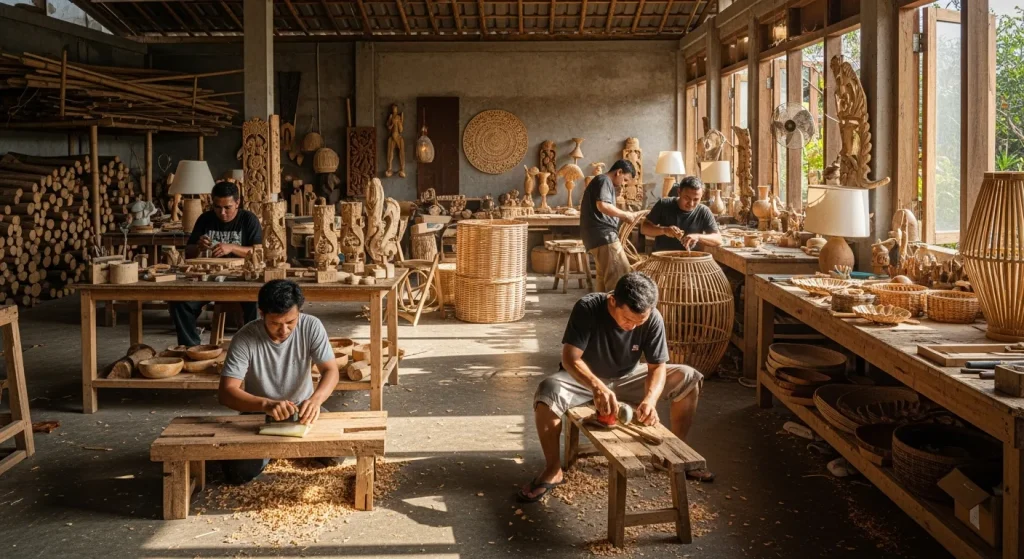
Indonesia’s home decor market, including Bali-made products, is projected to grow from approximately USD 10.1 billion in 2024 to USD 11.1–11.3 billion by 2027, demonstrating an annual growth rate of around 3–4%. This segment, particularly Bali home decor wholesale, is a strategically important export and tourism-driven niche, growing faster than the domestic average due to international demand and e-commerce.
Comparison: Wholesale Bali Decor vs. Dropshipping for Your 2027 Retail Business
As an importer, wholesaler, retailer, or interior contractor targeting the growing home decor market, understanding the optimal sourcing strategy is critical. This article provides a detailed comparison between traditional wholesale purchasing of Bali decor and dropshipping for your 2027 retail operations, focusing on practical implications for trade buyers.
1. Market Size & Growth (Indonesia/Bali Context)
The Indonesian home decor market, which encompasses Bali’s artisanal output, is experiencing robust growth. The market reached USD 10.07 billion in 2024 and is projected to reach USD 14.19 billion by 2033, demonstrating a Compound Annual Growth Rate (CAGR) of 3.88% from 2025–2033. IMARC’s 2025 valuation of USD 10.46 billion, with a 3.73% CAGR from 2026–2034, suggests an Indonesian market size of approximately USD 10.9–11.2 billion by 2027.
A separate study by 6Wresearch indicates the home decor market in Indonesia is expected to record a growth rate of 9.85% by 2027. This higher near-term growth rate, compared to IMARC’s medium-term average, suggests an acceleration driven by rising middle-class incomes and urban renovation demand within Indonesia, alongside strong regional competition in Asia.
Implication for Bali Wholesale
Bali’s home decor production, including furniture, handicrafts, and natural-material decor, is primarily integrated into Indonesia’s broader furniture and handicraft export statistics and domestic tourism spending. Specific numerical isolation for “Bali home decor” is not readily available from major sources. However, given Bali’s prominence as an artisanal and tourism hub and the strong export orientation of many producers, it is a reasonable working assumption that Bali-linked production accounts for a mid-single-digit percentage of Indonesia’s total home decor and handicraft economy. Export-oriented producers often exceed the 3–4% national decor CAGR, particularly those serving Western and Asia-Pacific importers.
2. Wholesale Bali Decor: Advantages and Disadvantages for 2027
Advantages of Wholesale
- Cost Efficiency: Purchasing in bulk from a Bali wholesaler typically yields lower unit costs. This allows for higher profit margins when selling to your end customers.
- Quality Control: Direct engagement with a wholesale supplier like Bali Home Decor Wholesale enables stringent quality checks before shipment. You can verify materials, craftsmanship, and adherence to specifications, ensuring product integrity.
- Brand Building & Exclusivity: Wholesale allows for curating unique collections, potentially including custom designs or exclusive ranges not available to dropshippers. This strengthens your brand identity and market differentiation.
- Inventory Management: While requiring capital, holding inventory provides immediate fulfilment capabilities, reducing lead times for customers and enhancing satisfaction.
- Freight & Logistics Control: Trade buyers manage their own freight, enabling selection of preferred shipping lines, consolidation of orders, and optimisation of shipping costs for larger volumes.
- Customer Experience: Direct control over the product means fewer discrepancies, consistent quality, and the ability to handle returns and exchanges efficiently, fostering customer loyalty.
Disadvantages of Wholesale
- Capital Investment: Requires upfront capital for inventory purchase, shipping, customs duties, and warehousing.
- Inventory Risk: Potential for unsold stock, obsolescence, or damage if not managed effectively.
- Logistics Complexity: Managing international shipping, customs clearance, and local warehousing requires expertise and resources.
- Minimum Order Quantity (MOQ): Wholesalers typically enforce MOQs, which can be prohibitive for smaller businesses or those testing new product lines.
3. Dropshipping Bali Decor: Advantages and Disadvantages for 2027
Advantages of Dropshipping
- Low Startup Capital: No need to purchase inventory upfront, significantly reducing initial investment.
- Reduced Inventory Risk: You only pay for products once a customer places an order, eliminating the risk of unsold stock.
- Wide Product Selection: Ability to offer a broad range of Bali decor items without holding physical inventory.
- Flexibility & Scalability: Easy to add or remove products, test market demand, and scale operations without logistical constraints of physical stock.
- No Warehousing or Fulfilment: The dropshipping supplier handles storage, packaging, and shipping directly to the customer.
Disadvantages of Dropshipping
- Lower Profit Margins: Dropshipping typically involves higher per-unit costs compared to wholesale, eroding potential profit.
- Limited Quality Control: Reliance on the supplier for product quality and accuracy. Inconsistent quality can damage your brand reputation.
- Supplier Dependence: Your business is heavily reliant on the dropshipping supplier’s inventory levels, pricing, shipping times, and communication.
- Complex Returns & Customer Service: Handling returns and customer inquiries can be complicated when you do not physically control the product or shipping process.
- Branding Challenges: Difficult to establish a strong brand identity when products are shipped directly from a third-party supplier, often with generic packaging.
- Longer Shipping Times: International dropshipping from Bali can involve extended shipping periods, potentially disappointing customers accustomed to faster delivery.
- Lack of Exclusivity: Products offered via dropshipping are often widely available, making differentiation difficult.
4. Key Considerations for 2027: Wholesale vs. Dropshipping
The choice between wholesale and dropshipping for Bali decor in 2027 hinges on your business model, capitalisation, and strategic objectives. The Indonesian home decor market’s projected growth, with near-term acceleration, suggests an environment ripe for both models, but with distinct requirements.
Business Model Alignment
For established retailers, interior designers, or larger e-commerce platforms aiming for brand integrity, consistent quality, and higher margins, wholesale purchasing from a reputable supplier like Bali Home Decor Wholesale is generally the preferred route. This model supports brand differentiation and direct control over the customer experience.
For new ventures, individuals testing market interest, or businesses with limited capital seeking to minimise risk, dropshipping can serve as an entry point. However, the long-term viability and profitability in a competitive market might be constrained by the inherent limitations of this model.
Capital and Risk Tolerance
Wholesale demands significant upfront capital and a higher tolerance for inventory risk. This is offset by greater control and higher potential returns. Dropshipping minimises capital outlay and inventory risk, making it suitable for lean operations, but at the cost of lower margins and reduced control.
Customer Experience and Branding
In 2027, customer expectations for quality, delivery speed, and brand experience will remain high. Wholesale allows you to dictate these factors, offering a superior and consistent customer journey. Dropshipping, by its nature, delegates much of this to a third party, potentially leading to inconsistencies that dilute brand perception.
5. Operational Comparison Table
The following table summarises key operational aspects for wholesale and dropshipping of Bali decor, providing a quick reference for trade buyers considering their 2027 strategy.
| Feature | Wholesale Bali Decor | Dropshipping Bali Decor |
|---|---|---|
| Initial Investment | High (inventory, shipping, customs) | Low (no upfront inventory purchase) |
| Profit Margins | Higher (due to lower unit costs) | Lower (higher per-unit costs) |
| Quality Control | Direct (pre-shipment inspection possible) | Indirect (reliant on supplier) |
| Inventory Risk | Present (potential for unsold stock) | Minimal (no stock held) |
| Shipping & Fulfilment | Managed by buyer (freight forwarder) | Managed by supplier |
| Shipping Times | Variable, controlled by buyer’s freight choice | Potentially longer, controlled by supplier |
| Customisation/Exclusivity | High potential | Limited to none |
| Branding Opportunity | Strong (packaging, curated selection) | Weak (generic shipping) |
| Customer Service Control | High | Low (dependent on supplier communication) |
2027 Note: By 2027, with the Indonesian home decor market experiencing accelerated growth rates of up to 9.85%, suppliers who have invested in robust supply chain management and quality control, typical of wholesale operations, will be better positioned to meet increased international demand for authentic Bali decor. This growth underscores the importance of reliable sourcing, which is a core advantage of wholesale.
6. Conclusion and Strategic Recommendation
For businesses seeking to establish a strong, reputable brand in the Bali decor market with sustainable profit margins and direct control over product quality and customer experience, wholesale purchasing remains the superior strategy. While requiring greater capital investment and logistical management, the benefits of higher margins, quality assurance, and brand building far outweigh the initial complexities.
Dropshipping may offer a low-risk entry point, but its inherent limitations in terms of quality control, profit margins, and brand building make it less suitable for long-term, scalable retail businesses aiming for market leadership in authentic Bali decor.
We recommend a direct wholesale relationship to ensure the authenticity, quality, and timely delivery of your Bali home decor inventory for 2027 and beyond. For detailed information on our product range and wholesale terms, please request a wholesale quote on WhatsApp.